Tuesday, April 29, 2025
Complicate Home Organization Ordeal
I am dealing with a growing home organization problem that is becoming more complicated by the minute. It recalls for me several concepts and theories. (I'll get to my specific home organizational issue after this..)
1. John McKinlay’s groundbreaking article in 1975, A Case for Refocussing Upstream; the Political Economy of Illness (here is an updated version from 2019)https://iaphs.org/.../2019/11/IAPHS-McKinlay-Article.pdf (more on this at the end of this piece, because it is interesting and important and includes an example from my long-ago Peace Corps Jamaica experience)
2. The theory of “Infinite Regress”, summed up by, “"The world is supported by four elephants standing on the back of a giant turtle, which is standing on the back of another giant turtle, which is standing on the back of another giant turtle..." Eggs exist because they are laid by chickens; and, of course, chickens are hatched from eggs."
3. And, needless to say, the parable of “The Cat in the Hat Comes Back” is relevent, too. Dr. Seuss, 1958, where the Cat turned all the snow pink, so to clean it up, he shoots all the pink snow into the house, on the wall. The kids balk at the pink wall, so he cleans it up with mom's dress, which is even worse, so he slaps the mess on the dress onto the hall rug, etc. (order may be wrong, but you get the idea.) Kind of the opposite of my problem, but reminiscent. He was lucky to have something I wish I had: a lot of progressively smaller, hardworking cats under his hat!
Okay, so here’s what’s going on for me:
I was lying in bed, looking at my hopelessly disorganized bedroom closet, and especially at the messy shoe rack, with surrounding debris. The shoe rack is overgrown and sitting awkwardly below my hanging clothes. I’m thinking a fix would be to move the rack to this niche next to the bed. I could leave the winter boots, etc, on the clothes closet floor.
The problem is that the niche next to my bed is full of art supplies and a pile books that are somewhere on my list to read. Where can I move the drawing supplies and books so I can put the shoe rack there?
I know; the books can go on the big bookshelf in the backroom (after I sort through and get rid of books I don't need, to make the space), the drawing supplies could go in the closet in the backroom.
But that closet is full of an overflowing tub of Camino/camping gear. So that has to be dealt with first. What I need to do is sort and consolidate my camping stuff into a larger bin with a lid. That would leave room for the drawing stuff on top.
Where can I get a big bin? Oh, I know. I have a couple of large bins with lids on the back porch that contain all the stuff - mine and donations from students - I had to supply my “Mosaic Art with Found Objects” classes I used to teach. We’re talking, beads, wooden sticks, broken necklaces, marbles, toy trucks, old house keys, bags of yellow lentils, beer bottle caps, broken porcelain figurines, etc., etc. I don’t need those anymore and the guy at “Off Center Arts” downtown says he’s all about making art with found objects and he’d be happy to have them. So I need to organize and consolidate the big bin into usable items and take it down to Off Center Arts, then I can use the bin for my camping gear.
Oh, he also wants any extra yarn I have that I won’t use, and where did I put all the yarn? I think it's in several places... It's somewhere in this closet full of vintage toaster and phones that I need to find another place for........
More on Kinlay's Upstream/Downstream Determinates of Health" this idea is based on this anecdote: “Sometimes it feels like this. There I am standing by the shore of a swiftly flowing river and I hear the cry of a drowning man. So I jump into the river, put my arms around him, pull him to shore and apply artificial respiration. Just when he begins to breathe, there is another cry for help. So I jump into the river, reach him, pull him to shore, apply artificial respiration, and then just as he begins to breathe, another cry for help. So back in the river again, reaching, pulling, applying, breathing and then another yell. Again and again, without end, goes the sequence. You know, I am so busy jumping in, pulling them to shore, applying artificial respiration, that I have no time to see who the hell is upstream pushing them all in.
Here's an example of how this idea relates to health interventions.
When I was in the Peace Corps in Jamaica many years ago, I was tasked, as a health educator, to go up to a remote village in the mountains to teach new moms - and soon to be moms - in the health clinic about nutrition, because there had been several cases of malnutrition of infants there. Driving up there in the Health Ministry jeep, we had to get out several times to move debris and the driver used a chainsaw to cut up fallen trees that were blocking the road. At the village clinic, I first surveyed the women about what foods they had to feed themselves and their children. It was a limited list, missing some important nutrients. Then I asked them what kinds of foods they didn't have that they WISH they did. They said fruits, fish, fresh milk, etc. I asked how/why they didn't have those things? They said because they are all available in Port Antonio at the bottom of the hill, but they couldn't get there, because the road was often impassable. Also, because most of their husbands worked on the banana boats coming into Port Antonio at the bottom of the hill, and - with the transportation difficulties - they often couldn't get to their jobs, so they were low on money.
"Why doesn't the government fix and maintain the road?" I asked. Their belief was that it was because their Parliament representative belonged to one political party and most of the people in this village belonged to the other (lots of animosity between the two, if you can imagine such a thing!).
So, after spending some time in that village, I found out that a group of women had been organized by the Ministry of Health some years before to carry out a mosquito-eradication/dengue fever prevention campaign in the area. The program came to an end, but the women continued to meet informally to do embroidery, share child care, and other things together.
So we re-organized that group to advocate for fixing the road. They needed to present this problem to the member of Parliament that was thwarting it, and also find a candidate to replace him if he wouldn't.
If I were to just teach the women how they had to change their and their babies' diet, it would be blaming the victim, which is often the case in health education campaigns. We needed to move upstream to find the impediment to good nutrition in the village.


Sunday, June 18, 2023
Go Karts
It's been a while, but I'm back! I'm a subject in a couple of interesting trials, but I'll talk about that later. Today the story is about Go Karts.
(Grandson) Eli and I went to Hinkle's Family Fun Center to play miniature golf on Saturday. At the counter, I saw that kids under 5 years old cost $3 and kids over that cost $8. So I told Eli to go look at something else/make himself scarce while I claimed he was 4, but he refused. Sissy. And no senior discount, so it was $8 for him and $9 for me! That was for only 9 holes, but when we get to the ninth hole where the hole steals your ball, we skip that one and go on and play the rest of the 8 courses. Skip the 18th hole and you can play all day. Duh!
But then I wanted to race Go Karts, so I put some funds on Eli's Fun Card so he could go play VR games while I did my thing. When I got up to the counter for the Go Kart ticket, the guy says, looking past me, "For how many?" I said, "Just one." He said, "What age?" (assuming I guess that I was buying the ticket for somebody else.) "I'm 68, Jeez, dude!" I should have said, "7" and gotten a discount, but then they'd want the 7 year old to stand against the wall to see if the kid was over the minimum height line, and then, busted.
I' m sorry to brag, but I'm just saying that nobody can beat me in Go Karts! The first race, it was me against eight 20s-30s guys. I told them in line that I would beat them all. They rolled their eyes and one said he HAD HIS OWN Go Kart and has raced it, so he would win. Blah blah blah.
They let 4 out of the gate before me, so they were well ahead. I am cutthroat and fearless and eventually beat them through every corner. The guy right behind me tried his best to squeeze past but sayonara, sucker. We bumped hard in one corner but I prevailed. I came over the finish line alone. The guy with his own go kart congratulated me at the end and conceded the race. You live in Albuquerque? I will take on all comers.
Oh, and when the attendant guy was escorting me up to the Kart and checking my seat belt I said I bet him $20 I would come in first. He said, "Sounds good!" And then when I did it, I went back to him to collect and he said, "Oh, I thought you meant you were betting with somebody else in line." Loser.
Tuesday, April 11, 2023
Oh, going back to all this blog stuff is so confusing! I've written some good stories elsewhere and I need to find out how to consolidate them here. My last Spanish Camino walk, through Portugal, I posted on https://findpenguins.com/jillgat It's a good platform because it plots on a map where you are along the way. And then I am writing stories on Facebook that just get lost, so I should copy them here. I don't know if you enjoy them, but when I read my stories from long ago, I laugh out loud, because I have such a lousy memory and I don't remember it was me who wrote them.
So now it is 2023. Byron rides his bike 35+ miles every morning and then spends the rest of the day napping between taking Lucy (his sweetie puppy) for walks, to fields to chase balls and to different dog parks. And he is creating these genius cartoons using Eli's characters (Frog, Ginger, Rocky, Potato, Kyle, et al) and usually based on conversations he has with Eli. Eli spends most weekends with us.
I start every day with a long "To Do" list, which I cherry pick each day for the funnist things and then do other stuff that isn't on the list and the rest of the items get carried over. I have new chickens (the neighbor's dog ate my last ones), I'm building a new chicken fence for them, I buy frozen mice at the pet store that I thaw out to feed to my loyal roadrunner friends who hang out in the front yard. And I have one last elderly gerbil, a huge fat toad I rescued as a pollywog just before the Rio Grande dried up last year, a box turtle that just came out of hibernation, and two parakeets. And Lucy the chihuahua and Jackie, who was rescued from the Navajo reservation and is AT LEAST 18 years old now.
I have a million mosaic art projects going on, many mosaic classes I teach at my house and other venues around town, I'm making soap and candles which are inexplicably popular and could make money for me if I cared enough to focus on that, which I don't. Found out that all the Black McGruders in Alabama are related to me by blood via a Magruder ancestor of mine who was a slave-owner who fathered children with an enslaved woman, and we were on TV about this family story and I visited them in Alabama. Lots of pictures and stories about that (will add later).
I got diagnosed with ADHD (DUHH!), and got on treatment. I entered a clinical trial as a test subject and found out I have biomarkers that are predictive of Alzheimer's Disease, which makes it more pressing to me that I record all of this stuff before I start fading out... I've also got four knitting projects in the works and am reading several books: one by a woman who rode her bike around the world (and then got hit and killed by a car on her bike when she got home, bummer) and another book about Anasazi ruins and history in the Southwest.
Etc. I hope I will find time to expand on all of this and add pictures, but thought I'd at least barf it all here for now as a placemarker. Thanks for listening!
Thursday, December 30, 2021
San Antonio, New Mexico
The route we usually take from Albuquerque to White Sands is south on I-25, then turn off at San Antonio and follow that lonely road west to Carrizozo, then south to Alamogordo (my favorite graffiti on that road was in a rest area, "Here I sit, my buns a'flexin', giving birth to another Texan).
San Antonio isn't really a town anymore, less than 100 people live around there now. Most travelers stop in San Antonio for the famous green chile cheese burgers at the Owl Bar. But there are other interesting things about San Antonio.
It was a bustling mining town at one time and the train came through there. Around the turn of the century A.H. "Gus" Hilton opened a merchantile store near the tracks, which also included a small hotel, and his young son, Conrad (who was born in San Antonio), would meet the train and carry passengers' luggage from the train to the hotel. Conrad grew up, started his own hotel in Cisco, Texas and, after that, a chain of hotels.
Then the mine dried up, floods took away a lot of the farmland, and the Hilton Merchantile burned to the ground. They were able to save the wooden bar from Hilton's store and installed it in the Owl Bar and Cafe, where we sat to eat our green chile cheeseburgers. The Crystal Palace, an old dance hall, still stands down the road, but most remnants of the town are gone. Pictured below is the vacant lot where the Hilton Merchantile and Hotel were located. No signage identifies it. I like to picture what would have happened to Paris Hilton if her grandfather hadn't started that hotel chain. She's probably be living in a trailer outside of Socorro now.
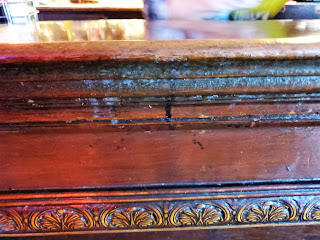


 Just past San Antonio is another mostly ghost town, San Pedro. I have a habit of visiting old cemeteries around the state (and recording what I find on FindAGrave.com for people searching for their ancestors), and I love traveling with little Eli, because he can't stop me from doing that!
 With my imaginary tour group, before we turned off at San Antonio, we would have already stopped at Sevilleta Wildlife Refuge, the Bosque del Apache (famous for birdwatching), San Acacia to see the longhorn cattle and an Indian ruin, pottery sherds and pictographs on a hill there and a couple of sites to see the ancient Camino Real.
Thursday, May 16, 2019

Getting ready to start another Camino, this time from Porto, Portugal to Santiago de Compostela, Spain. I would like to at least keep some kind of blog this time, but wondering what platform to use. Problem is I don't feel like putting too much energy into the tech logistics of it after walking all day. My goal would be to post one of those breezily articulate, humorous, thoughtful diaries, interspersed with pictures of the trip. If only it were that easy with just a phone. I don't even remember how to do any of that, while comfortably at home with a real computer.
Wednesday, August 5, 2015
August, 2015 Update
So now it is August 4, 2015 and I'm not sure what I wrote last.
Job: At some point I moved from doing Clinical Research in the UNM Emergency Dept to UNM Project ECHO (Check it out, it is an extraordinarily creative and effective public health intervention that is spreading all over the world) I loved the program, had a well-paying management position, but felt tied to my desk and with so many diverse and changing expectations, stress, deadlines and supervising people, etc. kind of took some of the fun out of it. I got a partial retirement (will get the rest of it when my Dept. of Health retirement kicks in in 2 years) and started working at Albuquerque Healthcare for the Homeless in December, 2014. They wanted to interview me for a management position because of all my experience and I had to do a real sales job to convince them to hire me in a much lower position, working directly with clients. I ran the outreach van, doing syringe exchange and harm reduction education with mostly people addicted to opiates. Also ran a women's group for homeless women. Great work! I enjoyed the client interaction very much, but have found that i am less and less patient, tolerant of supervision, administrative policies, etc. Long story short, at age 60, I've been written up for insubordination twice and got a week suspension without pay once. Then I tore my rotator cuff at work (lifting boxes of syringes onto the outreach van!) and had to fight to get Workers Comp - got the sense people thought I was bilking the system or lying in some way. I didn't realize it would be an adversarial thing.... I've paid into the system for years and the employer has insurance for it, but anyhoo. Will go back at some point, preferably parttime.
In the meantime, my mosaic mailbox business is doing very well: www.mirafloresmosaics Also teaching a very popular Intro to Mosaic Art class through UNM Continuing Education. Hoping to figure out a way to do some classes at my house, too, but not sure how to market it.
Health: So I had rotator cuff surgery on June 19th and have been in a humiliating arm immobilizer sling ever since (I'm 6 weeks out now). Starting physical therapy this Friday, Aug. 7, and am so looking forward on working to get my range of motion back. I figured that even with this sling, I could at least hike, but didn't realize how only having one mobile arm affects the balance and ability to stop a fall from happening. So I went down hard on my knee and now it's infected (I really want to post a pic here of it, but you will never want to eat scrambled eggs on a red plate again if you see it.) I'm on antibiotics and that's enough about that.
Travel There was a wonderful trip to Istanbul and southern Turkey at some point that I'm not sure I've written about. I highly recommend spending some time in Turkey. My brother is a Turkish citizen now and married to Necla, who is from there, so they were fantastic guides. In Dec./Jan., Olivia and I spent a couple of lovely weeks in Oaxaca, southern Mexico and then a week in Mexico City, meeting and getting to know our second cousins, the Chirinos, there. As you may recall, I finally found them after over a decade of research, seeking this lost branch of my family. Lovely folks! Patricio, my second cousin and his wife, Pao Castillo, Patricio's father Patricio (who was a member of the President's cabinet and the governor of Veracruz in the past), and son/grandson Patricio, my second cousin once removed and Olivia's third cousin. Also my other second cousins, Patricio's sisters, Monica y Andrea. Fabulous people! We had a wonderful time and Olivia got to visit the Frida Kahlo blue house museum. Have lots of stories and photos from that trip I should include here at some point.
Also on the topic of Travel, I have my sights set on walking 500 miles across Spain on the ancient pilgrimage route, the Camino de Santiago Compostela in June 2016. I often think about and plan this trip as a way to avoid pesky chores, repressed hostility, boredom, thinking about the parts of my future I don't want to think about. It works! I am hoping that Olivia will walk with me, but I'm fine to walk it alone, too.
More on this later. So I'm back.
Job: At some point I moved from doing Clinical Research in the UNM Emergency Dept to UNM Project ECHO (Check it out, it is an extraordinarily creative and effective public health intervention that is spreading all over the world) I loved the program, had a well-paying management position, but felt tied to my desk and with so many diverse and changing expectations, stress, deadlines and supervising people, etc. kind of took some of the fun out of it. I got a partial retirement (will get the rest of it when my Dept. of Health retirement kicks in in 2 years) and started working at Albuquerque Healthcare for the Homeless in December, 2014. They wanted to interview me for a management position because of all my experience and I had to do a real sales job to convince them to hire me in a much lower position, working directly with clients. I ran the outreach van, doing syringe exchange and harm reduction education with mostly people addicted to opiates. Also ran a women's group for homeless women. Great work! I enjoyed the client interaction very much, but have found that i am less and less patient, tolerant of supervision, administrative policies, etc. Long story short, at age 60, I've been written up for insubordination twice and got a week suspension without pay once. Then I tore my rotator cuff at work (lifting boxes of syringes onto the outreach van!) and had to fight to get Workers Comp - got the sense people thought I was bilking the system or lying in some way. I didn't realize it would be an adversarial thing.... I've paid into the system for years and the employer has insurance for it, but anyhoo. Will go back at some point, preferably parttime.
In the meantime, my mosaic mailbox business is doing very well: www.mirafloresmosaics Also teaching a very popular Intro to Mosaic Art class through UNM Continuing Education. Hoping to figure out a way to do some classes at my house, too, but not sure how to market it.
Health: So I had rotator cuff surgery on June 19th and have been in a humiliating arm immobilizer sling ever since (I'm 6 weeks out now). Starting physical therapy this Friday, Aug. 7, and am so looking forward on working to get my range of motion back. I figured that even with this sling, I could at least hike, but didn't realize how only having one mobile arm affects the balance and ability to stop a fall from happening. So I went down hard on my knee and now it's infected (I really want to post a pic here of it, but you will never want to eat scrambled eggs on a red plate again if you see it.) I'm on antibiotics and that's enough about that.
Travel There was a wonderful trip to Istanbul and southern Turkey at some point that I'm not sure I've written about. I highly recommend spending some time in Turkey. My brother is a Turkish citizen now and married to Necla, who is from there, so they were fantastic guides. In Dec./Jan., Olivia and I spent a couple of lovely weeks in Oaxaca, southern Mexico and then a week in Mexico City, meeting and getting to know our second cousins, the Chirinos, there. As you may recall, I finally found them after over a decade of research, seeking this lost branch of my family. Lovely folks! Patricio, my second cousin and his wife, Pao Castillo, Patricio's father Patricio (who was a member of the President's cabinet and the governor of Veracruz in the past), and son/grandson Patricio, my second cousin once removed and Olivia's third cousin. Also my other second cousins, Patricio's sisters, Monica y Andrea. Fabulous people! We had a wonderful time and Olivia got to visit the Frida Kahlo blue house museum. Have lots of stories and photos from that trip I should include here at some point.
Also on the topic of Travel, I have my sights set on walking 500 miles across Spain on the ancient pilgrimage route, the Camino de Santiago Compostela in June 2016. I often think about and plan this trip as a way to avoid pesky chores, repressed hostility, boredom, thinking about the parts of my future I don't want to think about. It works! I am hoping that Olivia will walk with me, but I'm fine to walk it alone, too.
More on this later. So I'm back.
Subscribe to:
Posts (Atom)